
Advice for Your Next Career Move
Welcome to the FindUpeople Prep Zone: practical advice to help you prepare, communicate your strengths and make informed career choices.
Start with the guides below, then register your career interests or ask us for support. For help taking part in recruitment, visit Inclusive Recruitment.
Writing a CV: make the evidence easy to find
Start with your name, contact details and a short summary of the work you want to do. Put the skills and experience most relevant to the role near the top. Use straightforward headings such as Experience, Education and Skills, and explain any technical terms a reader may not know.
For each role, show what you did and the difference it made. “Answered customer enquiries and kept accurate records” is more useful than a list of personality adjectives. Use numbers only when you can support them. Check dates, spelling and contact details, then save a clearly named PDF or Word document. Avoid adding identity documents, bank details or other information that is not needed for an initial enquiry.
Interview preparation: build a small bank of examples
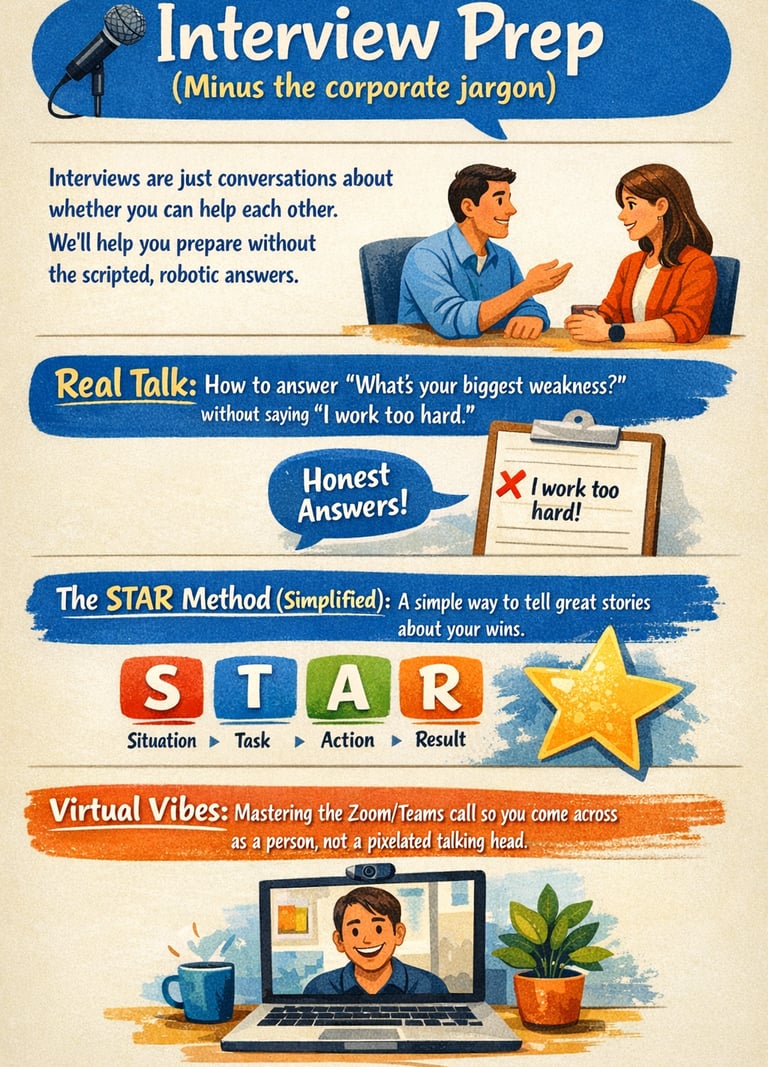
Read the role description and identify the main skills the employer needs. Prepare three or four examples from work, study, volunteering or personal projects. For each, explain the situation, your task, what you did and the result. Keep the focus on your own contribution, and be honest about what you learned.
Before the interview, confirm the time, format, location or meeting link, who you will meet and whether there is a task. Prepare questions about the day-to-day work, expectations and support. If an adjustment would help you demonstrate your skills, ask in advance through our adjustment-request route.
Job searching: choose your priorities
Write down your essential requirements and where you can be flexible: responsibilities, location, travel, working pattern and pay expectations. Keep a simple record of applications and next steps. Tailor each application to the essential requirements rather than sending the same statement everywhere. Check who is recruiting before sharing personal information.
Career development: find the next useful step
You do not need to solve your whole career at once. Identify one skill you want to use more and one you want to develop. Compare them with the work you are interested in, then choose a practical next step: a project, course, conversation or application. When considering an offer, ask what support and progression look like in practice.
Workplace communication: make expectations explicit
Ask how priorities, deadlines and feedback are usually shared. If written instructions, an agenda or a brief follow-up summary help you work well, say so. Check your understanding of a task by restating the outcome and deadline. Discuss communication preferences with the person involved rather than assuming everyone works in the same way.
Inclusive recruitment: ask for what helps you take part
Recruitment arrangements can sometimes be adapted. Explain the part of the process you find difficult and what would help, such as clearer task instructions or time for a break. You can start by describing the adjustment you need without putting a diagnosis in your initial enquiry. Read how to request support.
Graduates and early-career candidates: use all your experience
A first CV can draw on coursework, projects, part-time work, caring responsibilities and volunteering. Describe the relevant skills you used: organising work, solving a problem, communicating or learning something new. Explain what you contributed and what you would do differently next time. A clear account of your potential is more useful than trying to sound experienced in everything.
Register your interest in future roles or ask FindUpeople a career question.
CONNECT
Bringing talent and opportunity together seamlessly.
CONTACT US
© 2026 GARWOOD GROUP LIMITED trading as Findu.
Company number 15795066. All rights reserved.
INFORMATION HUB
Brickfield Business Centre, 60 Manchester Road, Northwich, CW9 7LS